|
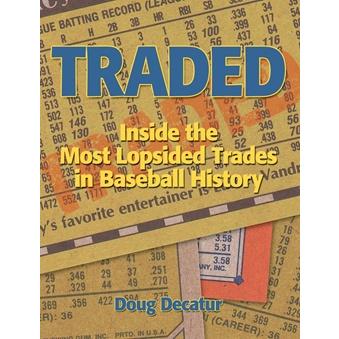
Traded Reviewing a Book on the Most Lopsided Trades Ever by Keith Glab, BaseballEvolution.com
There are many other things you can do with Win Shares, other than compare players. You can evaluate trades... if we can evaluate a trade, then we can evaluate trading strategies. When teams trade an outfielder for a pitcher of the same age, who usually wins? -- The New Bill James Historical Baseball Abstract It took nearly a decade, but someone finally spearheaded Bill James' notion of using Win Shares to evaluate trades and made a comprehensive listing of the most lopsided trades in the history of Major League Baseball. That someone was Doug Decatur, and that listing can be found in his new book, Traded. To evaluate a trade, Decatur simply tallied up the future Win Shares for every player involved in a major 20th century deal. Whether a player was traded again or lost to free agency after the trade in question was deemed irrelevant, which is the only practical and fair way to approach the issue. He found 306 trades that had a net value of 111 Win Shares or more for a team and listed them, along with the best trades for each individual team. He also tallied team totals - the Cleveland Indians wind up as the best wheelers and dealers of the 20th century, while the Oakland Athletics are the team that everybody swindles. The most lopsided trade in the 20th century? That would be the infamous Glenn Davis deal. The Orioles traded Curt Schilling, Steve Finley, and Pete Harnisch to the Astros for Glenn Davis and a net gain of 609 future Win Shares or 203 future wins. While no doubt lopsided, I think everyone - particularly Astros fans - would have a difficult time considering this the most lopsided trade in history. Most people would select the trade of George Herman Ruth to the New York Yankees for $125,000 - a miscue that cost the Boston Red Sox 576 future Win Shares and 84 years of championship-deficient baseball. The reason that Astros fans wouldn't consider that the most lopsided trade is because those the deal didn't actually benefit Houston that much. Although Schilling went on to have a Hall-of-Fame worthy career, he pitched just 56 games in relief as an Astro before being traded to the Phillies for Jason Grimsley in what Decatur calculates as the 90th-worst trade of the 20th century. Finley and Harnisch each had a decent four-year stretch in Houston before departing themselves in lopsided trades. What happened is that Schilling and Finley were both very late bloomers, so even the Astros did not quite know what they were relinquishing. In fact, at the time of the Davis trade, the former first-round pick Harnisch seemed to have the brightest future of the trio. While there is no practical method for objectively evaluating trades on that level, it is something to be mindful of in perusing Decatur's rankings, particularly during the free agency era. A small market team might trade a player whose impending free agency would make him impossible to retain. Should that team be penalized for only getting marginal prospects in return for such a player? Clearly, the rankings in Traded are just an objective starting point for the discussion of the most lopsided trades in history. The context of the trades is needed, which Decatur ably provides in the team sections. The other reason most people would go with the Ruth trade over the Davis trade is the star factor. Below-average-to-bad players still accumulate Win Shares, and average players can really rack them up if they play long enough. But it is far easier to replace the performance of an average player with a Triple-A body than it is to replace that of a star, and, of course, it is impossible to replace the performance of Babe Ruth. Finley, Harnisch, and Schilling were all better-than-average players, but I don't think anyone would trade Ruth straight up for those three knowing how those careers would pan out. Perhaps a better example is the Delino DeShields for Pedro Martinez trade. This was without question one of the most lopsided deals ever, but it only ranks as the sixth-best trade in Expos history, 11th-worst in Dodgers history, and the 255th most lopsided trade ever. Pedro enjoyed one of the most dominant pitching stretches ever while DeShields was a slightly above average player for just over a decade, but Delino's longevity puts his Win Share total closer to Pedro's than the actual value of each player warrants. The best way to approach this sort of trade would be value over replacement player, whether that be Win Shares, linear weights, or something else. Using raw Win Shares to evaluate trades was a trailblazing idea a decade ago and still a good method now, but it probably isn't the very best we an do these days. That segues into the other issue with this book, and indeed, most that are published by ACTA Sports: the treatment of Bill James as a demigod. There is every reason to believe that Win Shares Above Replacement wasn't used mostly because James himself hasn't developed and endorsed such a system. Decatur also quotes James every few pages to support whatever argument he is making. I happen to agree with most of the arguments as presented by Decatur/James, but it would make for a more balanced and persuasive argument (as well as a better read) if Decatur were to go to multiple sources, or simply just do a better job of explaining himself rather than constantly saying, "see, Bill James agrees with me, so I must be right."
Caveats aside, this is still a fun book to read, and the lessons that Decatur draws from the extensive research he has done are illuminating. In the case of trading prospects for star players in July to make a postseason run, Decatur makes a compelling case that such trades generally aren't worthwhile. One missing piece of evidence, however, is that those star players often leave consolation draft picks behind once they depart via free agency. It would be extremely interesting to see a study of how such compensation picks fared in the future. White Sox GM Kenny Williams, however, should not have needed a database of trade history to know that it would be better to spend $2 million on six months of Jim Thome as opposed to $4 million on one month of Manny Ramirez. That is math that is way simpler than the calculation of Win Shares. Disagree with something? Got something to add? Wanna bring up something totally new? Keith resides in Chicago, Illinois and can be reached at keith@baseballevolution.com. |