|
Upon reflection, Giants fans had to know going in that the
task at hand wasn’t going to be an easy one. Just three teams in National League
history have ever repeated as World Series champions, and none have done it
since the Big Red Machine did it in 1975-76 (the 1921-22 New York Giants and the
1907-08 Chicago Cubs were the others). Still, they seemed primed for a potential
repeat. The pitching that carried them through that magical September and
October run had returned and they had a full season of Buster Posey, the
2010 Rookie of the Year, to look forward to. The colorful Band of Misfits, that
together had accomplished what no one else believed they could, had returned
almost entirely intact. It was easy to be optimistic in April. Heck, it was easy
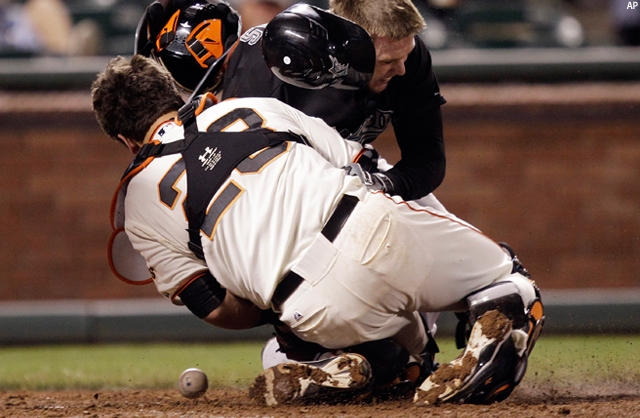
to be optimistic all the way up until May 25, the night Scott Cousins
sent the Giants’ aspirations of a repeat spiraling off-course with a
clean-but-unnecessarily-hard collision at home plate with Posey.
What Went Wrong Injuries It’s easy to point to all the injuries the Giants suffered as the main culprit for their demise, but that wouldn’t really be accurate. Nevertheless, it’s hard to ignore the overwhelming effects of the injuries the Giants witnessed in 2011. In addition to losing Posey for the year to a devastating ankle injury, second baseman Freddy Sanchez went down just a scant two weeks after Posey with a season-ending shoulder separation. Among players with at least 100 PA in a Giants uniform this year, Sanchez (.289) and Posey (.284) ranked 3rd and 4th in batting average. The team’s best hitter, third baseman Pablo Sandoval (.315 BA, .909 OPS, 23 HR), missed 40 games from the end of April through the middle of June due to a broken hamate bone in his hand and played down the stretch with an painful right shoulder that prevented the switch-hitting Panda from batting right-handed. At times in September, Sandoval would sit versus tough lefties, or else face them batting left-handed. At one point the Giants even pinch-hit for him rather than be forced into a lefty-versus-lefty situation. Even their mercenary rental player, Carlos Beltran, was not spared from the vicious injury bug that plagued the team. Beltran missed two weeks with an injured hand shortly after being acquired from the Mets in exchange for top pitching prospect Zack Wheeler. Beltran hit .323/.369/.551 in 179 plate appearances for San Francisco after the July 27 deal, including .378/.434/.700 in September. All told, the Giants saw 18 different players sidelined in 2011, using the disabled list a whopping 23 times. Starting pitchers Jonathan Sanchez and Barry Zito were sidelined twice each, as was closer Brian Wilson, outfielder Andres Torres, and utility player Mark DeRosa. Outfielders Pat Burrell, Nate Schierholtz, and Cody Ross also spent time on the DL, as did rookie 1B/OF Brandon Belt and shortstop Miguel Tejada. Burrell’s foot injury is likely serious enough to force him into retirement. For one key stretch in August, the Giants were without their top two relievers in Wilson and Sergio Romo. Offensive Woes Injuries alone, however, don’t paint a complete picture, nor should they be used as an excuse for failing to repeat as NL West champions. After going 2-6 in the immediate aftermath of Posey’s run-in with Cousins, the Giants bounced back to go 32-22 (.593) in June and July and led the D-backs by 2 games entering the month of August. That’s when things began to really unravel. San Francisco won just 11-of-29 games (.379) during the season’s dog days, dropping the team six games behind Arizona and nine games behind the Wild Card leading Braves (though only a half-game behind the eventual Wild Card and World Series winner, St. Louis). Though they bounced back in September (14-11), the August deficit proved to be too much to overcome. Were injuries to blame for this collapse? The short answer, is no. For the year, the Giants posted the second best team ERA (3.20) in all of baseball and in August, that mark was even lower (3.08). However, despite acquiring Beltran just prior to the July trading deadline, San Francisco’s impotent offense sputtered through the month, scoring only 78 runs in 29 games, an average of just 2.69 per game. After beating Philadelphia in Beltran’s July 28 debut, the Giants then lost five-in-a-row and 8-of-their-next-9. Their collective team OPS in August was .636, the worst mark in either league by a wide margin, and they scored two or fewer runs 17 times in the month, winning just three of those games. The Giants' offense ranked 29th in the big leagues in runs (570 total; 3.52 per game) and on-base percentage (.303) - behind only Seattle in both categories - and 27th in both batting average (tied - .242) and OPS (.671). They scored one run or fewer in a game 36 times, the sixth-highest total in majors, and won just two of those games, meaning that they were 84-42 (.667) when scoring at least two runs. When plating three runs or more, that mark jumped to 73-19 (.793) and they were a remarkable 55-9 (.859) when scoring four or more runs in a game. Only the Phillies had a better mark (.796) when they scored three or more, while no team had a better record than San Francisco when watching four runs or more cross home plate. Predictably, however, no team played in fewer such three- and four-run games than did the Giants. Individually, the Giants had just one player (Sandoval) with more than 14 home runs and only three players total in double digits (Ross 14, Aubrey Huff 12). Only Sandoval topped the 60 RBI plateau (he had 70). A year after propelling San Francisco to the title by hitting .290/.385/.506 with 26 HR and 86 RBI (while making a bargain $3 million), Huff stumbled to the finish line with a mediocre .246/.306/.370 slash line with only 12 HR and 59 RBI, this despite playing in a team-high 150 games. Additionally, Huff hit a full quarter of his season home run total on just one warm June night in St. Louis. Huff, who was re-signed after the 2010 season to a two-year deal worth at least $22 million (the deal includes a $2 million buyout of a $10M, 3rd-year option), was chided by management for not doing enough in the off-season to prepare. Yet he was just one of several veteran players who underperformed a year after playing a large role in the Giants run to the championship. Torres saw his OPS drop from .823 to .643 (including just .550 from the left side of the plate), while Burrell, who hit 18 home runs in 96 games for San Francisco in 2010 after he had been rescued from the scrap heap, hit just seven long balls in 92 games in ’11. Ross batted a disappointing .240 with a .730 OPS a year after being named the NLCS MVP. The shortstop position was a veritable offensive black-hole all season long. It was manned by over-the-hill vets Miguel Tejada and Orlando Cabrera, rookie Brandon Crawford, and utility player Mike Fontenot. Collectively, the Giants mustered a mere .210/.265/.299 line from their shortstops, with only Crawford contributing in a positive way defensively. But the biggest drop-off in offensive production predictably came from behind the plate following the loss of Posey, where journeymen backups Eli Whiteside and Chris Stewart joined rookie Hector Sanchez for a collective .200/.271/.306 line in his place. Injuries surely played a big role in the Giants failure to repeat, but the team’s offense, or rather their complete lack of it, was a far bigger reason why they came up short. There were, of course, other factors. Those Fifth Starter Blues As good as the Giants' pitching may have been overall it didn’t go unblemished. Jonathan Sanchez began the season slotted in the second spot in the rotation, but by the end of the year, he had essentially pitched his way out of San Francisco. No learned Giants fan would deny the immense talent the team recently traded to Kansas City (the Giants simply would not have won the 2010 World Series without him going 4-1 with a 1.01 ERA in the final month of the season, nor will anyone soon forget his 2009 no-hitter versus San Diego, the first by a Giant in 33 years). It nevertheless became clear to most, as Sanchez struggled to a 4-7 record with a 4.26 ERA and 66 walks in 101.1 innings pitched, that the time to trade the inconsistent lefty had finally come. As tantalizingly un-hittable as Sanchez could be, his high walk totals and accordingly high pitch counts often prevented him from going deep into games, continually taxing the team’s bullpen and frequently digging a deep hole that the club’s anemic offense simply could not overcome. He reportedly further alienated himself to GM Brian Sabean with his inability to return after spraining his ankle in August. And with a price tag sure to top $6 million in 2012, he was also just too darned expensive to keep. As exasperating as Sanchez could be, Barry Zito, save for one three-game stretch, was just downright awful, posting a 3-4 record and a 5.87 ERA in just 53.2 innings pitched in between stints on the disabled list. Zito did return from an April ankle injury to win three straight starts while allowing just three earned runs in 21 innings, but he then surrendered 19 runs in his next 15.2 innings before injuring his foot on July 31. He returned from his second stint on the DL in September and allowed four more runs in four innings of relief work. 24-year old rookie left-hander Eric Surkamp received a handful of starts down the stretch in September, in place of that injured pair of veteran lefties, and pitched better than his 5.74 ERA reflected, yet showed clearly enough that he is still a work in progress and not likely ready for a full-time role in 2012. The (Lost) Magic Inside Baseball is often said to be a game of inches - a series of lucky breaks going one way or the other. While in 2010 the Giants always seemed to be on the right side of every close call, lucky bounce, and tough break, there was no such fortune to be had in 2011. Likewise, the chemistry that made those 2010 Misfits so special also seemed to be lacking. Both Tejada and Aaron Rowand complained privately about playing time before both were released in late August, and there were reportedly similar self-centered grumblings heard around the clubhouse after the team acquired Beltran from the Mets. In spite of its lackluster offensive performance, San Francisco still led the NL West by three games at the end of play on July 27, the day they acquired the Beltran. Yet after acquiring Beltran from New York, Jeff Keppinger from Houston, and Cabrera from the Indians within a two-week span leading up to the July 31 deadline, San Francisco had effectively turned over three-eighths of its starting lineup. Suddenly players who had helped put the team in first place to begin with were now getting squeezed out of opportunities to contribute further, while at the same time watching their lead in the West slip away. The team’s offensive struggles in August, including their precipitous slide in the immediate aftermath of acquiring Beltran, could also indicate that there was an overreliance on their newly-acquired, would-be-savior. Sort of a collective way of saying, “ok, here you are, now save us.” You have to wonder if perhaps the Beltran deal, along with the other accompanying moves, didn’t have a reverse psychological effect on the team in that it sent the wrong message, like management telling them they didn’t think they were good enough. Endorsement deals and reality shows likely also did little to help retain the cohesiveness and camaraderie that made them so special just a year earlier. In short, the Magic Inside the 2010 Giants failed to recreate itself in 2011. What Went Right Pitching, Pitching, Pitching… With a final record of 86-76 and a second place finish in the West, the season clearly was not a complete failure and one thing that did go right for San Francisco in 2011 was the same thing that carried them to the top of the baseball world in 2010: their pitching. The Giants' bullpen ERA of 3.04 was bettered only by the 3.03 mark tallied by the Braves, while the collective 3.28 ERA posted by the club’s starting pitchers was second only to the impressive 2.86 mark posted by Philadelphia’s vaunted rotation. In fact, four Giants starters placed in the top 11 in the National League in ERA and all four even wound up receiving Cy Young votes, while three of them were also named All-Stars. With a record of 13-14, Tim Lincecum may have appeared to have had a down year, but much of that is belied by the lack of run support he received. According to ESPN.com, he had the worst run support average in the majors at 3.82 runs per nine innings. In his 33 starts, San Francisco compiled a team record of 17-16 while scoring a grand total of 22 runs in those 16 losses, four of which were shutouts. He even lost four times to eventual Cy Young Award winner Clayton Kershaw by final scores of 2-1, 1-0, 2-1, and 2-1. In many ways, Lincecum’s numbers were actually better in 2011 than they were in 2010. His ERA, 5th in the NL at 2.74, was nearly half a run lower than a year before and he surrendered fewer hits and had a lower WHIP. His strikeout numbers dipped a bit, but that was simply a matter of pitching effectively to contact, as evidenced by the lowest line drive percentage he’s recorded (18%) since his rookie year and a groundball-out-to-flyball-out ratio (1.32) that was the highest he has posted in five big league seasons. Co-ace Matt Cain’s 12-11 record speaks much to that same lack of support, as he posted the sixth-lowest run support average (4.63) in the majors. The Giants were 18-15 in games started by Cain, scoring two runs or fewer in 12 of those 15 losses. In his ten no-decisions, Cain posted an ERA of 2.36. For the season, his 2.88 ERA was the eighth-best in the NL while his 1.08 WHIP was fifth. He held opposing hitters to a .217 batting average, good for third in the league (and just ahead of Lincecum at .222) and his OPS against (.597) ranked fifth. The club might have actually placed four starters in the top ten in ERA had it not been for one historically bad game by sophomore lefty Madison Bumgarner, who for the season went 13-13 with a 3.21 earned run average. Excluding his June 21 Turbo Tanking against the Minnesota Twins (0.1 IP, 9 H, 8 ER), Bumgarner registered a nifty 2.86 ERA in his remaining 32 starts covering 204.1 innings pitched. It was, sadly, the same old song and dance though in terms of run support, as the Giants scored two runs or fewer in 13 of his 33 starts, including 11 of his 13 losses. About the most remarkable aspect to the Giants' season was the return to the big leagues of Ryan Vogelsong, a former Giants farmhand who was once the key player in the Jason Schmidt-to-Pittsburgh deal back in 2001. Since making his last major league appearance with the Bucs in 2006, Vogey had toiled in Japan (from 2007-09, including stints in the Japanese bush leagues) and in the minors (in 2010, having been signed and later cut by both the Angels and Phillies), before being re-discovered last winter by Giants coaching instructor Guillermo Rodriguez while pitching in Venezuela. Whether an amazing breakthrough season or a remarkable comeback story, the 33-year old Vogelsong was just about the Giants' top pitcher in 2011, earning a well deserved mid-season All-Star selection. Promoted from Triple-A Fresno in mid-April when Zito was injured fielding a bunt in Arizona, he went on to make 30 appearances for the Giants, going 13-7 with a 2.71 ERA, the fourth-best mark in the National League and sixth best overall in the majors. He was remarkably consistent all season long, allowing three earned runs or fewer in all but three of his 28 starts, but just like his fellow staff members he was saddled with run support issues. In his seven losses - including four by shutout- the Giants scored a grand total of just four runs. One of baseball’s best bullpens in 2010 was one of the best again in 2011 despite various injuries to several key members. Brian Wilson finished with 36 saves and a 3.11 ERA despite two trips to the DL while Sergio Romo, who also missed time with a sore elbow in August, put up video game-type numbers, giving up 29 hits in 48 innings while striking out 70 and walking just five (one intentionally). While he limited left-handed hitters to a paltry .229 average, right-handers hit a mere .150 against him in 120 at-bats. Left-hander Jeremy Affeldt (2.63 ERA) saw his season end in early September when he lacerated his non-pitching hand while making his kids lunch, and righty Santiago Casilla (1.74 ERA) missed the first two months with inflammation in his elbow, but both were key contributors and pitched very effectively when healthy. Meanwhile, right-handers Ramon Ramirez (2.62 ERA) and Guillermo Mota (77 K in 80.1 IP) and lefty Javier Lopez (2.72 ERA) managed to avoid the injury bug and were just as dependable as they were down the stretch in ’10, meaning that more-often-than-not, a lead taken deep into the game meant a win in the books. A Panda Comeback Bouncing back from a weight-induced sub-par 2010 season that saw him benched in the post-season, Sandoval was a rare bright spot for the Giants' offense in 2011, despite his missing a quarter of the year with a broken hand and playing another month of it injured. His OPS, down from .943 in 2009 to .732 in 2010, rebounded to a robust .909 in ’11 after working himself back into shape and losing 38 pounds last winter. But it wasn’t just an offensive rebound for Sandoval. He posted a defensive +/- total of +26 to lead all major league third basemen, and a 12.3 UZR, which ranked second only to NL Gold Glove winner Placido Polanco (14.0). Some might even argue that he was more deserving of that particular piece of hardware than Polanco was. Regardless, the Panda was once again a force to be reckoned with for San Francisco, both at the plate and in the field. Part 2: Where They Go From Here Team Previews/Reviews Index Do you have a different take? Send your opinions to submissions@baseballevolution.com. |